![[personal profile]](https://www.dreamwidth.org/img/silk/identity/user.png) rainsometimes
rainsometimesFirst, a note on two titles that could have been here but wasn't: Saint Young Men/Saint Oniichan will instead be covered under V for its French translation, Vacances de Jésus et Bouddha.
I thought about including the josei manga Suppli by Mari Okazaki, but I've only read the 5 volumes translated into English, after which it seems to have gone into permanent hiatus. The French translation continues beyond that, but I haven't read any of it yet. And while I saw much to like in the first five volumes, it feels like the kind of romance story where I would like to read it until the end before I rec it. EDIT as of June 2013: I've now finished the story: my rec post for it is here./edit
Une sacrée mamie by Saburo Ishikawa (art & adaptation) and Yoshichi Shimada (original story)

This 11-volume manga is based on a bestselling autobiographical novel by Japanese comedian Yoshichi Shimada, which has also become a movie and a TV series. (The original title is Saga no Gabai bā-chan; the French title translates to something like One Heck Of A Grandma.) Several of the manga volumes have a disclaimer that the content in them is only loosely based on the memoir, so while the French translation does list Yoshichi Shimada as co-creator, it seems to me more probable that Saburo Ishikawa has written as well as drawn all the stories but took some of the content (as well as the setting and the main characters) from the original book.
Anyway, it goes like this: in early 1950s Hiroshima, the main character's mother has a hard time feeding and taking care of her two sons, even with her sister's help. Finally, she sends away her younger son, Akihiro Tokunaga, to live with her mother in the country. The transition is a shock to city boy Akihiro; his grandmother proves to live in an isolated ramshackle building of no modern facilities, and she gets her main food staple from fishing vegetables the local merchants toss away into a nearby stream. But while she has little money, she is very thrifty and full of tricks; and Akihiro soon learns to adapt and get on with the local children.
And from there on, the stories follow a very episodic slice-of-life structure, chronicling the life of a young boy in rural Japan in the 1950s. Sometimes there is a certain flavour of Moral Lessons in the air, but it's always with humour and a light hand. Akihiro's grandma really is a pretty wise woman a lot of the time, but she's not infallible, and she's still funny. The rest of the characters are fun to get to know too, and I quite adore the drawing style with its friendly, down-to-earth cartooniness and well-done backgrounds. (Sample page here.) There is perhaps a tone of nostalgia and certainly a good-natured humour about it; but also the heartfelt passion of a child. Some scenes are quite moving, and all the stories enjoyable.
Skip Beat! by Yoshiki Nakamura

Skip Beat! is the story of Kyoko Mogami (pictured to the left above), who's determined to make it big in show business as a way of taking revenge on the guy she grew up with and had a crush on since childhood. This self-centred jerk had convinced her to drop out of high school and follow him to Tokyo so he could have someone support him while he focused on his music career; but once his career got going, he had no use for her and let her know it quite cruelly. The previous self-effacing Kyoko who's always tried her best to please everyone around her turns into a vengeful fury. But then, bit by bit as she starts on a long road trying to become an actress, she realises she likes acting for its own sake and wants to learn more, inspired by the well-known actor Ren Tsuruga, who somehow keeps crossing her path...
Skip Beat! has got to be the most fun shōjo I know. Yoshiki Nakamura's skill at comedy rivals Rumiko Takahashi's and Eiichiro Oda's, while being different from either's. A large part of the humour in the story comes from Kyoko herself, who's at the same time very distinct and striking and very versatile. Quite outside her forays into acting (where she will, naturally as well as for the sake of drama, often have trouble at the start of getting into a role), she can turn on a dime from cheerful and enthusiastic to a storm of vengeful fury sending out tiny demon-like sprites called "grudge Kyokos" to a "saleswoman's smile" that's all eager to please to being full of melodramatic despair to comically gray apathy to over-the-top affectionate squee (this last nearly always directed either at super-cute objects or at her friend Kanae "Moko" Kotonami, herself a great and funny character whose friendship with Kyoko is one of my favourite elements of the story); and so much more.
"Over the top" plus "no brakes" is in fact a pretty good summation of Kyoko's personality in general - though Nakamura also does know how to tone her down to good effect, keeping her heroine believable and sympathetic throughout. And there are also ever-so-often continuous glimpses of the sadder sides of Kyoko's past and personality, years of loneliness when she'd repressed all sides of herself that weren't cheerful and dutiful. In fact, you can choose to read this part of Skip Beat! as an indictment of women being made to feel they have to be the sweet homemaker and nothing else. (Who knows if this view will be born out at the end of the story, but as of now that seems like a valid interpretation.)
I've said nothing yet of the romance part, but of course we are meant to root for Ren Tsuruga and Kyoko Mogami getting together. Tsuruga is a very prominent character and pretty interesting himself, having his own dark past and many hidden sides. Personally I've found over time to be less interested in him as the love interest and more as his own person, weirdly perhaps. (Especially since Kyoko is repeatedly scared
of displeasing him as her mentor, though arguably she unconsciously chooses that reaction because she's even more scared of falling in love.) But while I personally find myself drawn a little more to Kyoko's acting and her friendship with Moko, the romantic elements are also well handled.
Star-Gazing Dog by Takashi Murakami

Star-Gazing Dog is the title of both a rather slim manga book and the story that takes up around two thirds of the volume, with the rest of it belonging to a sequel or companion story called Sunflowers. It's a quiet little road movie of a story about a man who takes off in his car after his life has taken a sharp downturn in economy, health and family. He's only got his beloved dog beside him, Owner and dog go through a lot together and both care for and worry about the other. (The dog is in fact the main POV of the story, though we get to see the details and context the dog wouldn't understand so we can understand the whole picture.) It's a story both sad and heartwarming.
The companion piece is less sad and more uplifting, but perhaps also a bit more predictable, less hard-hitting. It's not bad as a companion piece or sequel, though, and I think I needed to read it at the time. But it's not what makes the manga.
******************************************
Creators
Hisashi Sakaguchi (Ikkyu)
Hiroaki Samura (Blade of the Immortal)
Karuho Shiina (Kimi ni todoke)
Tamako Shimura (Wandering Son)
Favourite characters
Sawako Kuronuma (Kimi ni todoke)
***************************************
Anime corner
Serial Experiments Lain
A very intriguing and thought-provoking anime with a fascinating atmosphere that eventually had me quite spell-bound as I watched it. Yet it's prevented from being one of my top favourites for its rather dark tone, shifting from gloomy to terrifying to melancholy much more often than to more heartwarming moments, though those exist too. I'd say Lain's journey into strength and self-realisation but also to horrors and anguish is well worth watching, just keep in mind it will go to dark places and is not the most uplifting or reassuring. (I confess I have yet to rewatch it, though I have felt tempted to now and then.)
Someday's Dreamers
Very, very different is this short series of a young girl with some magical talent in an alternative Earth where such are not unusual and where there's a system in place for learning how to master them and get your magic license. (Interestingly, in other respects this world seems just like our own, with the same technology level and all.) The main character gets to live next door to her young mentor and other cute boys while she learns about how to make people's lives better with magic - or not, as sometimes the best choice might be to do nothing. This clearly is a series that does aim for uplifting, and I remember thinking at times it can be a little too neat and orderly in its "our problem for the day" episode. (But bear in mind it's been a good while since I've seen it.) Nevertheless, I think it largely succeeds as a feel-good series with a sympathetic cast of characters.
Strange Dawn
This has got to be the most obscure anime series I've seen. Also only 13 episodes, only half of which came out on two English-language DVDs, so I had to buy French versions to find out how the story ended. (Unfortunately the person who got me into the series doesn't know French or Japanese, so I have no one to discuss the ending with. ;_;)
The story follows two Japanese high school girls, Yuko and Emi (or Eri, as she's confusingly called in the French version) who have suddenly ended up in a strange world through some weird summoning magic. It turns out that the inhabitants of this world are small rolypoly figures only reaching up to the girls' knees, who regard the two girls as "Great Protectors", legendary figures of great powers. (Their societies are pre-industrial and relatively primitive: they also have some unique customs like fixating on bare feet as something erotic.) But the apparent cuteness of these people is misleading - they're actually living in rival nations carrying out fierce, destructive wars, with the village where the girls first end up being threatened to be crushed between two forces. And naturally everyone wants to get the "Great Protectors" on their side, seeing them as a miraculous super-weapon. The nervous and well-meaning Emi starts to wonder if they can do something to stop the wars, while the harsher, no-nonsense Yuko points out that it's not their business and they don't really know the situation, so they should just demand to be taken home.
So there are personality conflicts and personal growing not just for the two leads but the locals we get to know the best, who start questioning old beliefs and try to figure out what the right thing to do truly is. And there is political intrigue and exciting battles, a mysteriously missing princess, jealousy and unrequited love and demands of honour and duty and so on. Although it did feel to me that it could have used a few more episodes in order to resolve some of the issues it raised - I do wonder if the writers were hoping for 26 episodes but weren't granted it - by and large I felt the ending was a satisfying conclusion to this rather different but interesting and rewarding series.
Spirited Away
And now I've nattered on so much about the other recs I hardly have any energy left to talk about this, one of my absolute favourite animated films of all time (and the only one of my top faves that I've seen in the cinema). Usually there are four other animated movies I consider just as good, and none better: but to be honest, if push came to shove and I had to pick one favourite and one favourite only, it would be the "story of Chihiro's mystical disappearance", a.k.a Spirited Away.
Of all Miyazaki's movies, here's the one where his unfettered imagination runs the closest to my own, while also giving me image upon image and scene upon scene I could never have thought of. Full of drama, satire, personal growth, enchanting small details and absolutely stunning visual sequences of fantasy and poetry, I could rave about this movie for ages. (I've restricted my list of Favourite Characters for this alphabet to manga characters only, but if I'd chosen to include anime-only people, Chihiro would be a given for C, just as Shizuku from Whisper of the Heart would certainly have been included in this entry. I love Chihiro's character arc, her believable moodiness at the start changing to fear and then despair and then to desperate and resilient courage.)
But I do want to get this post up now, so I'm afraid I'll have to short-change this most magnificent movie and just say there is none I would recommend more. ♥♥♥
And that's all... or at least all I can think of for now. What about you guys?
I thought about including the josei manga Suppli by Mari Okazaki, but I've only read the 5 volumes translated into English, after which it seems to have gone into permanent hiatus. The French translation continues beyond that, but I haven't read any of it yet. And while I saw much to like in the first five volumes, it feels like the kind of romance story where I would like to read it until the end before I rec it. EDIT as of June 2013: I've now finished the story: my rec post for it is here./edit
Une sacrée mamie by Saburo Ishikawa (art & adaptation) and Yoshichi Shimada (original story)
This 11-volume manga is based on a bestselling autobiographical novel by Japanese comedian Yoshichi Shimada, which has also become a movie and a TV series. (The original title is Saga no Gabai bā-chan; the French title translates to something like One Heck Of A Grandma.) Several of the manga volumes have a disclaimer that the content in them is only loosely based on the memoir, so while the French translation does list Yoshichi Shimada as co-creator, it seems to me more probable that Saburo Ishikawa has written as well as drawn all the stories but took some of the content (as well as the setting and the main characters) from the original book.
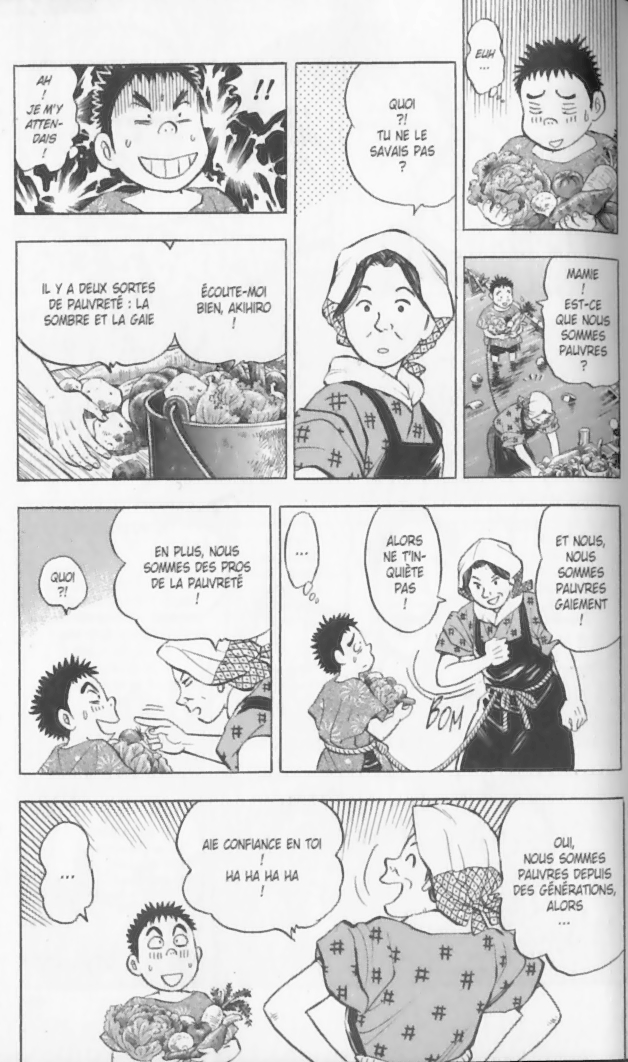
Anyway, it goes like this: in early 1950s Hiroshima, the main character's mother has a hard time feeding and taking care of her two sons, even with her sister's help. Finally, she sends away her younger son, Akihiro Tokunaga, to live with her mother in the country. The transition is a shock to city boy Akihiro; his grandmother proves to live in an isolated ramshackle building of no modern facilities, and she gets her main food staple from fishing vegetables the local merchants toss away into a nearby stream. But while she has little money, she is very thrifty and full of tricks; and Akihiro soon learns to adapt and get on with the local children.
And from there on, the stories follow a very episodic slice-of-life structure, chronicling the life of a young boy in rural Japan in the 1950s. Sometimes there is a certain flavour of Moral Lessons in the air, but it's always with humour and a light hand. Akihiro's grandma really is a pretty wise woman a lot of the time, but she's not infallible, and she's still funny. The rest of the characters are fun to get to know too, and I quite adore the drawing style with its friendly, down-to-earth cartooniness and well-done backgrounds. (Sample page here.) There is perhaps a tone of nostalgia and certainly a good-natured humour about it; but also the heartfelt passion of a child. Some scenes are quite moving, and all the stories enjoyable.
Skip Beat! by Yoshiki Nakamura
Skip Beat! is the story of Kyoko Mogami (pictured to the left above), who's determined to make it big in show business as a way of taking revenge on the guy she grew up with and had a crush on since childhood. This self-centred jerk had convinced her to drop out of high school and follow him to Tokyo so he could have someone support him while he focused on his music career; but once his career got going, he had no use for her and let her know it quite cruelly. The previous self-effacing Kyoko who's always tried her best to please everyone around her turns into a vengeful fury. But then, bit by bit as she starts on a long road trying to become an actress, she realises she likes acting for its own sake and wants to learn more, inspired by the well-known actor Ren Tsuruga, who somehow keeps crossing her path...
Skip Beat! has got to be the most fun shōjo I know. Yoshiki Nakamura's skill at comedy rivals Rumiko Takahashi's and Eiichiro Oda's, while being different from either's. A large part of the humour in the story comes from Kyoko herself, who's at the same time very distinct and striking and very versatile. Quite outside her forays into acting (where she will, naturally as well as for the sake of drama, often have trouble at the start of getting into a role), she can turn on a dime from cheerful and enthusiastic to a storm of vengeful fury sending out tiny demon-like sprites called "grudge Kyokos" to a "saleswoman's smile" that's all eager to please to being full of melodramatic despair to comically gray apathy to over-the-top affectionate squee (this last nearly always directed either at super-cute objects or at her friend Kanae "Moko" Kotonami, herself a great and funny character whose friendship with Kyoko is one of my favourite elements of the story); and so much more.
"Over the top" plus "no brakes" is in fact a pretty good summation of Kyoko's personality in general - though Nakamura also does know how to tone her down to good effect, keeping her heroine believable and sympathetic throughout. And there are also ever-so-often continuous glimpses of the sadder sides of Kyoko's past and personality, years of loneliness when she'd repressed all sides of herself that weren't cheerful and dutiful. In fact, you can choose to read this part of Skip Beat! as an indictment of women being made to feel they have to be the sweet homemaker and nothing else. (Who knows if this view will be born out at the end of the story, but as of now that seems like a valid interpretation.)
I've said nothing yet of the romance part, but of course we are meant to root for Ren Tsuruga and Kyoko Mogami getting together. Tsuruga is a very prominent character and pretty interesting himself, having his own dark past and many hidden sides. Personally I've found over time to be less interested in him as the love interest and more as his own person, weirdly perhaps. (Especially since Kyoko is repeatedly scared
of displeasing him as her mentor, though arguably she unconsciously chooses that reaction because she's even more scared of falling in love.) But while I personally find myself drawn a little more to Kyoko's acting and her friendship with Moko, the romantic elements are also well handled.
Star-Gazing Dog by Takashi Murakami
Star-Gazing Dog is the title of both a rather slim manga book and the story that takes up around two thirds of the volume, with the rest of it belonging to a sequel or companion story called Sunflowers. It's a quiet little road movie of a story about a man who takes off in his car after his life has taken a sharp downturn in economy, health and family. He's only got his beloved dog beside him, Owner and dog go through a lot together and both care for and worry about the other. (The dog is in fact the main POV of the story, though we get to see the details and context the dog wouldn't understand so we can understand the whole picture.) It's a story both sad and heartwarming.
The companion piece is less sad and more uplifting, but perhaps also a bit more predictable, less hard-hitting. It's not bad as a companion piece or sequel, though, and I think I needed to read it at the time. But it's not what makes the manga.
******************************************
Creators
Hisashi Sakaguchi (Ikkyu)
Hiroaki Samura (Blade of the Immortal)
Karuho Shiina (Kimi ni todoke)
Tamako Shimura (Wandering Son)
Favourite characters
Sawako Kuronuma (Kimi ni todoke)
***************************************
Anime corner
Serial Experiments Lain
A very intriguing and thought-provoking anime with a fascinating atmosphere that eventually had me quite spell-bound as I watched it. Yet it's prevented from being one of my top favourites for its rather dark tone, shifting from gloomy to terrifying to melancholy much more often than to more heartwarming moments, though those exist too. I'd say Lain's journey into strength and self-realisation but also to horrors and anguish is well worth watching, just keep in mind it will go to dark places and is not the most uplifting or reassuring. (I confess I have yet to rewatch it, though I have felt tempted to now and then.)
Someday's Dreamers
Very, very different is this short series of a young girl with some magical talent in an alternative Earth where such are not unusual and where there's a system in place for learning how to master them and get your magic license. (Interestingly, in other respects this world seems just like our own, with the same technology level and all.) The main character gets to live next door to her young mentor and other cute boys while she learns about how to make people's lives better with magic - or not, as sometimes the best choice might be to do nothing. This clearly is a series that does aim for uplifting, and I remember thinking at times it can be a little too neat and orderly in its "our problem for the day" episode. (But bear in mind it's been a good while since I've seen it.) Nevertheless, I think it largely succeeds as a feel-good series with a sympathetic cast of characters.
Strange Dawn
This has got to be the most obscure anime series I've seen. Also only 13 episodes, only half of which came out on two English-language DVDs, so I had to buy French versions to find out how the story ended. (Unfortunately the person who got me into the series doesn't know French or Japanese, so I have no one to discuss the ending with. ;_;)
The story follows two Japanese high school girls, Yuko and Emi (or Eri, as she's confusingly called in the French version) who have suddenly ended up in a strange world through some weird summoning magic. It turns out that the inhabitants of this world are small rolypoly figures only reaching up to the girls' knees, who regard the two girls as "Great Protectors", legendary figures of great powers. (Their societies are pre-industrial and relatively primitive: they also have some unique customs like fixating on bare feet as something erotic.) But the apparent cuteness of these people is misleading - they're actually living in rival nations carrying out fierce, destructive wars, with the village where the girls first end up being threatened to be crushed between two forces. And naturally everyone wants to get the "Great Protectors" on their side, seeing them as a miraculous super-weapon. The nervous and well-meaning Emi starts to wonder if they can do something to stop the wars, while the harsher, no-nonsense Yuko points out that it's not their business and they don't really know the situation, so they should just demand to be taken home.
So there are personality conflicts and personal growing not just for the two leads but the locals we get to know the best, who start questioning old beliefs and try to figure out what the right thing to do truly is. And there is political intrigue and exciting battles, a mysteriously missing princess, jealousy and unrequited love and demands of honour and duty and so on. Although it did feel to me that it could have used a few more episodes in order to resolve some of the issues it raised - I do wonder if the writers were hoping for 26 episodes but weren't granted it - by and large I felt the ending was a satisfying conclusion to this rather different but interesting and rewarding series.
Spirited Away
And now I've nattered on so much about the other recs I hardly have any energy left to talk about this, one of my absolute favourite animated films of all time (and the only one of my top faves that I've seen in the cinema). Usually there are four other animated movies I consider just as good, and none better: but to be honest, if push came to shove and I had to pick one favourite and one favourite only, it would be the "story of Chihiro's mystical disappearance", a.k.a Spirited Away.
Of all Miyazaki's movies, here's the one where his unfettered imagination runs the closest to my own, while also giving me image upon image and scene upon scene I could never have thought of. Full of drama, satire, personal growth, enchanting small details and absolutely stunning visual sequences of fantasy and poetry, I could rave about this movie for ages. (I've restricted my list of Favourite Characters for this alphabet to manga characters only, but if I'd chosen to include anime-only people, Chihiro would be a given for C, just as Shizuku from Whisper of the Heart would certainly have been included in this entry. I love Chihiro's character arc, her believable moodiness at the start changing to fear and then despair and then to desperate and resilient courage.)
But I do want to get this post up now, so I'm afraid I'll have to short-change this most magnificent movie and just say there is none I would recommend more. ♥♥♥
And that's all... or at least all I can think of for now. What about you guys?
no subject
Date: 2012-10-09 08:29 pm (UTC)(I was especially surprised to have my misconceptions about Skip Beat corrected - for some reason I thought she was trying to become a singing idol, which for some reason just doesn't hold as much appeal for me as aspiring actress does.)
For "S" I will have to mention my favorite shonen series, the venerable Saint Seiya. I've written somewhat at length about it here, but to steal a bit from myself: "Saint Seiya is cheesy, melodramatic, at times badly drawn – and yet for 25 years has managed to remain one of the most popular anime ever made. (I've been told that it has been shown in syndication in parts of Latin America continuously since it was dubbed.) It's a wonderful example of the shonen genre, where the scrappy underdogs have so much spirit and heart and determination that not even 100 broken bones, losing 2/3 of the blood in their body, or being punched at the speed of light can stop them. It was the direct inspiration for Sailor Moon, and was one of the series that provided raw material for the earliest waves of doujinshika. If you enjoy BL and shonen ai, Saint Seiya is probably one of the series you can thank for it. Because ... what else are you going to get from a series where the girls are so overwhelmingly outnumbered? The series that was unabashedly "bromantic" decades before that term was heard, chock-full of beautiful bishonen and biseinen wearing colorful latex, tossing waist-length hair of every color imaginable, and shedding manly man-tears over their fallen comrades.
The first few episodes are ... not that great. I might even say they're bad. But once you get to the fight between Seiya and Shiryu … well, you might find yourself falling under the spell, like I did back in 2003."
I should mention that, though Saint Seiya might sound like Drgonball Z with different hair, I found the two to be different enough in pacing, tone and aesthetic that even you might like it if you're generally not a shonen fan.
no subject
Date: 2012-10-09 09:06 pm (UTC)You do make Saint Seiya sound remarkably appealing in spite of it having few female characters (usually a drawback for me)! I often like old-fashioned stuff, anyway. And while there are shonen I love, Dragonball isn't really one of them, so I'm glad to hear Saint Seiya isn't much like it.
no subject
Date: 2012-10-09 09:32 pm (UTC)I DO remember back when my "anime mentor" first suggested I watch it (by loaning me her HK subs in late 2002) she stressed - after I whined about the first few episodes being boring and cheesy (and the substitles were awful) - just stick with it. She said, "Watch til episode 11" - she knew me SOOOO well, the tricky wench - and darn it if she wasn't right.
If you want to give it a try and can't find the original episodes, note that there are two English dubs - one by ADV (uncut and pretty good) and one by DiC (heavily edited and released in English as "Knight of the Zodiac" and loathed by many as the thing that killed Saint Seiya's chances in America.)
(I don't actually knwo what French fans think of the French dub, but I do know that the French fandom has been (still is?) very large and active. It was French fan-made videos, so so I'm told, that got the second series ( Hades arc) made in 2000, and the popularity of that might have been what led to the many other manga and anime sequels and prequels that followed.)
Anyhow, at the risk of offending DBZ fans, I couldn't ever get into DBZ because a) I found the art style very ... erm ... unappealing, and b) the english dub episodes I saw on American TV made them all seem like ... shouting, posturing 'roid monsters. Which didn't interest me. Saint Seiya has fighting too, and boasting and so forth, but it seems as though the character interactions are subtler and more complex.
no subject
Date: 2012-10-09 09:43 pm (UTC)I've gotten so many new recs now, so I think Saint Seiya is one of those I'll put on the shelf as "let it be until an easy opportunity arises", but that is still excellent to know!
I should probably clarify that I haven't even tried to watch the DBZ anime - I've only read (bits and pieces of) the Dragonball manga, and in a less than great translation at that. But I doubt I'd go for the anime either...